Key Takeaways
- Not just a wild dog: The dingo (Canis dingo) is an ancient canine lineage that diverged from domestic dogs thousands of years ago — with unique traits like rotating wrists and a 180° neck turn
- Australia's apex predator: Dingoes are the largest land-based predator on the continent and a keystone species that helps control feral cats, foxes, and rabbits
- 3,500+ years in Australia: Dingoes arrived via Southeast Asian seafarers and are legally classified as native animals under Australian federal law
- Conservation crisis: Pure dingo populations are declining due to hybridisation with domestic dogs, lethal government control programs, and habitat loss
- Not a pet: Keeping a dingo as a pet is illegal in most Australian states and strongly discouraged by conservation organisations
Table of Contents
- Introduction
- What Is a Dingo?
- Physical Appearance & Characteristics
- Watch: Dingo — Australia's Wild Dog
- Habitat & Distribution
- Diet & Hunting Behaviour
- Life Cycle & Reproduction
- Conservation Status & Threats
- Dingo vs Dog: Key Differences
- Can You Keep a Dingo as a Pet?
- Cultural Significance
- 10 Fascinating Dingo Facts
- Frequently Asked Questions
- Conclusion
Introduction
Few animals capture the spirit of the Australian wilderness quite like the dingo. With its lean, athletic build, piercing amber eyes, and signature sandy-gold coat, the dingo has roamed the Australian continent for thousands of years — long before European settlers ever set foot on its shores. Yet despite being one of Australia's most recognisable animals, the dingo remains widely misunderstood.
Is a dingo just a wild dog? Where did it come from? Is it endangered? Can you keep one as a pet? These are the questions that bring thousands of people to search engines every single month. In this comprehensive guide, we answer all of them — and much more.
Whether you're a wildlife enthusiast, a student researching Australian fauna, a traveller planning an outback adventure, or simply curious about one of nature's most fascinating canines, this article is your definitive resource on what a dingo is.
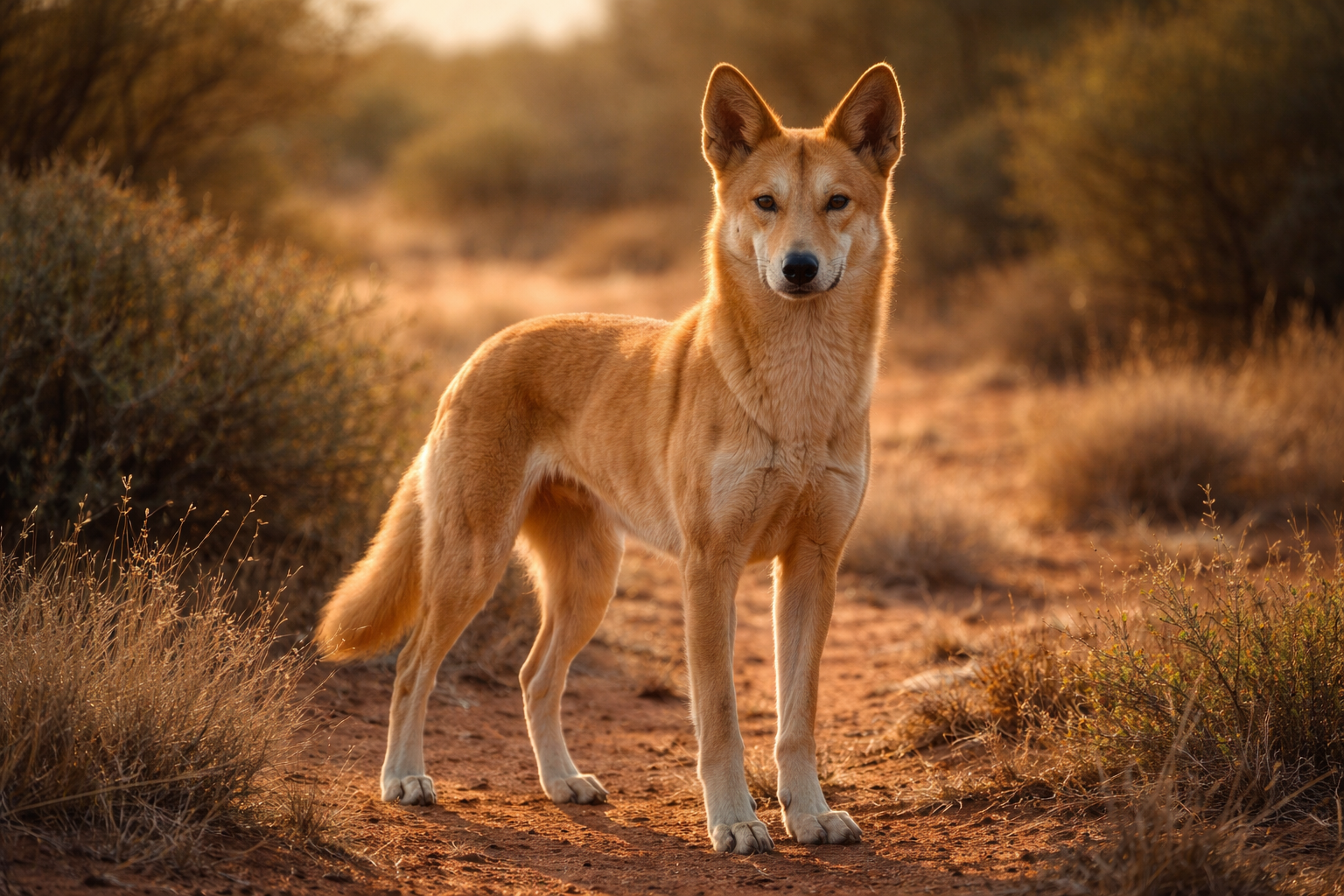
The Australian dingo — a lean, intelligent canine that has roamed the continent for over 3,500 years.
What Is a Dingo?
A dingo is a free-ranging canine found primarily across mainland Australia. Scientifically, it belongs to the species Canis dingo (though its classification is still debated — some scientists label it Canis lupus dingo or Canis familiaris dingo). What everyone agrees on is this: the dingo is not simply a "wild dog." It represents an ancient, basal lineage of canine that diverged from the ancestors of modern domestic dogs thousands of years ago.
Dingoes are more closely related to the New Guinea singing dog than to any domestic breed. They arrived in Australia approximately 3,500 to 4,000 years ago, most likely brought by seafarers from Southeast Asia. The earliest confirmed dingo fossil in Australia has been dated to roughly 3,250 years ago.
Is a Dingo a Dog?
This is one of the most commonly searched questions about dingoes, and the answer is more nuanced than a simple yes or no. Dingoes share a common ancestor with domestic dogs — both descend from wolves. However, the dingo lineage split away early, before the intensive selective breeding that created the domestic breeds we know today.
Key differences include: dingoes breed only once per year (domestic dogs can breed twice), they have larger canine teeth relative to body size, their jaws can open wider, their wrists can rotate (allowing them to use their paws almost like hands), and their necks can turn a remarkable 180 degrees — a feat impossible for domestic dogs. They also rarely bark, relying instead on howls and other vocalisations.
Physical Appearance & Characteristics
Dingoes are medium-sized canines with a lean, muscular build optimised for speed and endurance. They stand approximately 44–62 cm at the shoulder and measure 86–123 cm in body length, with a bushy, bottle-shaped tail adding another 26–38 cm. Males typically weigh between 13 and 24 kg, with females being slightly smaller.
Coat Colours & Regional Variations
The classic "ginger" or sandy-yellow dingo is the most recognised, but the species displays several naturally occurring colour variations across the continent:
| Colour Variant | Typical Habitat | Population % |
|---|---|---|
| Ginger / Sandy-Gold | Mainland Australia (most widespread) | ~88% |
| Sable / Black-Tan | Dense forests and heavily wooded areas | ~8% |
| White / Cream | Alpine regions (higher elevations) | ~4% |
| Coastal Sandy-Yellow | Coastal areas and islands | Subset of ginger |
Unique Physical Traits
- Rotating wrists that allow dingoes to grip, climb, and manipulate objects — almost like having hands
- Double-jointed limbs and a neck that rotates a full 180 degrees in any direction
- Independent ears that move separately and can rotate to face the back of the head
- Wide-opening jaws with large, evenly-spaced teeth and no dental overcrowding
- Remarkable athleticism: speeds up to 60 km/h, capable of jumping 2 metres high and climbing trees
Types of Dingoes
Alpine dingoes are stockier with broad, triangular heads and thick double coats that shed in summer. Desert and tropical varieties are leaner with narrower heads. Coastal and island dingoes (such as those on K'gari / Fraser Island) tend to be long-legged with larger foot pads. The black dingo (often searched online) is not a separate species but a naturally occurring colour morph found predominantly in forested regions.
Watch: Dingo — Australia's Wild Dog
🎬 Watch: Everything you need to know about Australia's iconic dingo.
Habitat & Distribution
Dingoes inhabit almost every type of landscape across mainland Australia — from the scorching red deserts of the interior and the tropical rainforests of the north, to the eucalyptus woodlands of the east and the snow-dusted alpine moorlands of the southeast. The only places they are absent are Tasmania (where they never naturally occurred), heavily urbanised areas, and the southeastern agricultural zones from which they were historically expelled.
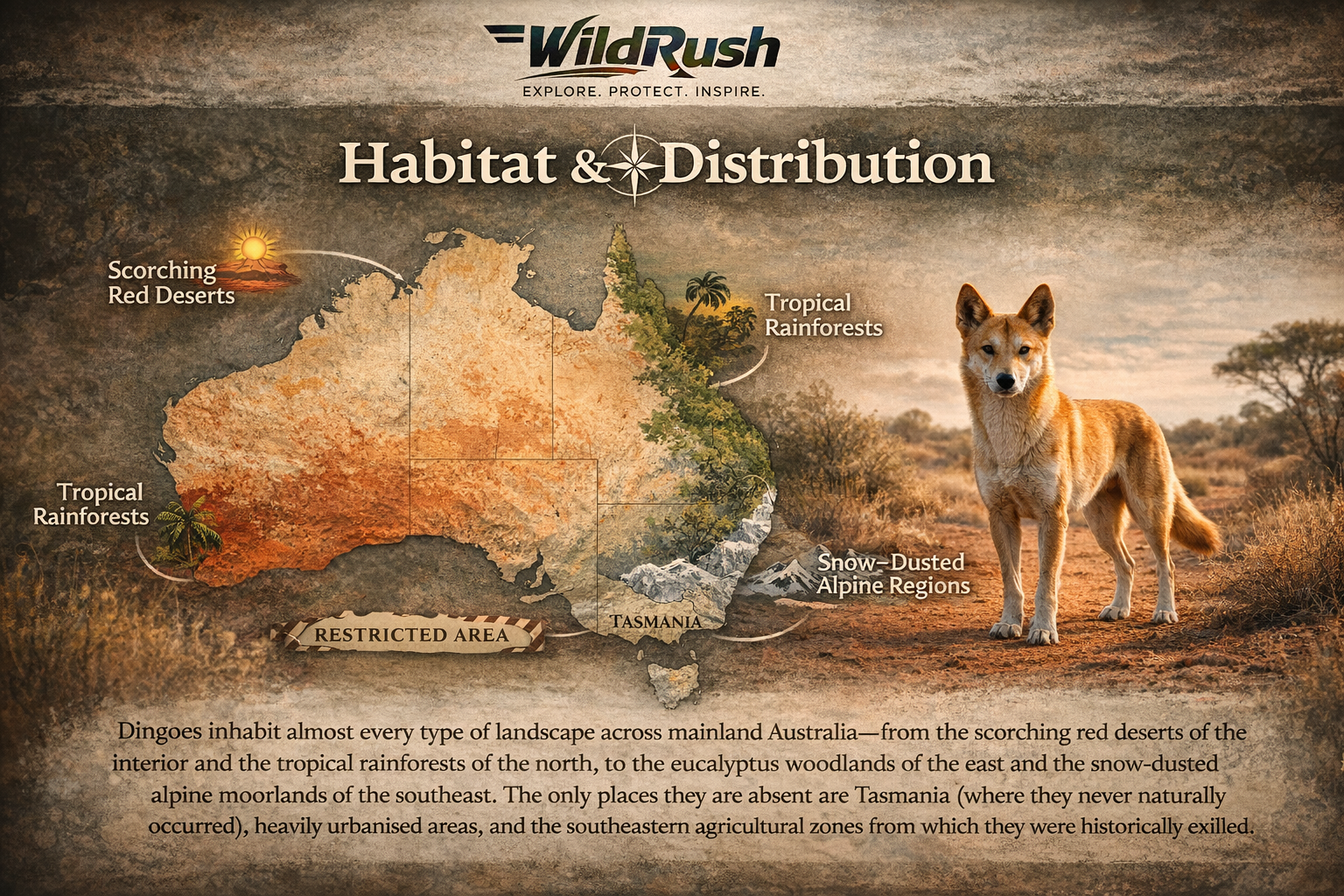
Dingoes thrive across diverse Australian landscapes — from scorching deserts to alpine moorlands and tropical rainforests.
Are Dingoes Native to Australia?
Strictly speaking, dingoes are not "original" to Australia in the way kangaroos or koalas are. They were introduced by human seafarers from Southeast Asia approximately 3,500–4,000 years ago. However, having lived on the continent for millennia — far longer than European settlement — they are legally and ecologically classified as native animals under Australian federal law (the Environment Protection and Biodiversity Conservation Act 1999 recognises species present before 1400 CE as native).
Where Do Dingoes Live?
Dingoes are found across most of mainland Australia, with the highest concentrations in northern and central regions:
- The vast arid deserts of Central and Western Australia
- Tropical wetlands and rainforests of the Northern Territory and Far North Queensland
- The alpine regions of the Great Dividing Range in Victoria and New South Wales
- K'gari (Fraser Island), Queensland — home to one of the purest dingo populations
- National parks and wilderness areas across every state and territory
Diet & Hunting Behaviour
What Do Dingoes Eat?
Dingoes are opportunistic carnivores with a remarkably broad diet. Research has found that roughly 80% of their diet nationwide is formed by just 10 species. They are apex predators — the largest land-based predator in Australia — and their hunting strategies vary based on terrain and prey availability.
Core prey includes kangaroos, wallabies, possums, wombats, rabbits, rodents, birds, reptiles, and insects. Since the introduction of non-native species, dingoes also hunt feral pigs, goats, cats, foxes, and hares. They occasionally consume fruit, grains, and aquatic life when available.
Social Behaviour & Pack Structure
Dingoes are social animals that live in packs of 3–12 individuals organised around a dominant alpha pair. Pack members cooperate in hunting, territory defence, and raising pups. They communicate through a sophisticated repertoire of howls, growls, and scent markings.
Interestingly, dingoes rarely bark. Their primary vocalisation is a haunting, melodic howl that can carry for kilometres across the outback. They are most active at dawn and dusk (crepuscular), though they can be nocturnal in areas with high human activity.
Territories are maintained through scent marking and vocalisations rather than physical confrontation with rival packs. Individual dingoes can travel 10–20 km per day within their territory, and have been tracked covering up to 40 km in a single day.
Life Cycle & Reproduction
Unlike domestic dogs, which can breed twice a year, dingoes breed only once annually — typically between March and June in Australia. This is one of the key biological distinctions that separates dingoes from domestic dogs.
| Life Stage | Details |
|---|---|
| Breeding Season | March–June (Australia); August–September (Southeast Asia) |
| Gestation Period | 61–69 days (average 63 days) |
| Litter Size | 1–10 pups (average 4–6) |
| First Venture from Den | ~3 weeks old |
| Weaning Complete | ~12 weeks old |
| Hunting with Adults | 3–4 months old |
| Lifespan (Wild) | 5–10 years (up to 14–18 in captivity) |
Only the alpha pair typically breeds within a pack. The alpha female actively suppresses breeding in subordinate females, and if another female does produce a litter, the alpha often kills the pups to ensure only her genetic line is propagated. All pack members participate in raising the surviving pups, creating a communal care system. Adult dingoes have even been observed adopting orphaned pups from other packs.
Conservation Status & Threats
The conservation status of the dingo is one of the most complex and contentious issues in Australian wildlife management. The picture is complicated by conflicting classifications, a patchwork of state laws, and an ongoing scientific debate about what a "pure" dingo actually is.
IUCN Status
The IUCN Red List classified the dingo as "Vulnerable" in 2008, citing the decline of pure dingo populations to around 30% due to hybridisation with domestic dogs. However, in 2018–2020, the IUCN reclassified the dingo as "Not Evaluated" after a taxonomic reclassification that regarded dingoes as feral domestic dogs. This reclassification remains controversial, and many Australian scientists and conservation organisations reject it.
Within Australia, the dingo's legal status is fractured. Victoria lists the dingo as "Vulnerable" under state legislation. Queensland protects dingoes in national parks but classifies them as a "restricted invasive animal" outside those boundaries. New South Wales groups them under "wild dog" legislation. This means a dingo can be a protected native animal in one paddock and a declared pest in the next.
Major Threats
- Hybridisation: Interbreeding with domestic and feral dogs dilutes pure dingo genetics, though recent genomic studies suggest this may be less extensive than previously feared
- Lethal control: Government-funded baiting (including 1080 poison), trapping, shooting, and bounty programs continue across agricultural regions
- Habitat loss: Urban expansion, agricultural development, and infrastructure reduce available dingo territory
- The Dingo Fence: While protecting livestock, the fence fragments populations and prevents gene flow between eastern and western groups
- Legal inconsistency: The patchwork of state-level regulations makes unified national conservation nearly impossible
Dingo vs Dog: Key Differences
While dingoes and domestic dogs share a common ancestor, thousands of years of divergent evolution have produced significant differences:
| Feature | Dingo | Domestic Dog |
|---|---|---|
| Breeding | Once per year (March–June) | Twice per year (any season) |
| Vocalisation | Primarily howls; rarely barks | Primarily barks |
| Wrist Flexibility | Rotating wrists (can climb trees) | Fixed wrists |
| Jaw | Opens extremely wide; larger teeth | Standard opening; dental crowding common |
| Neck Rotation | 180° in any direction | Limited rotation |
| Ears | Always erect; move independently | Varies by breed (floppy to erect) |
| Social Structure | Alpha-pair pack hierarchy | Varies; responds to human leadership |
| Domestication | Semi-wild; can be socialised but not fully domesticated | Fully domesticated over 15,000+ years |
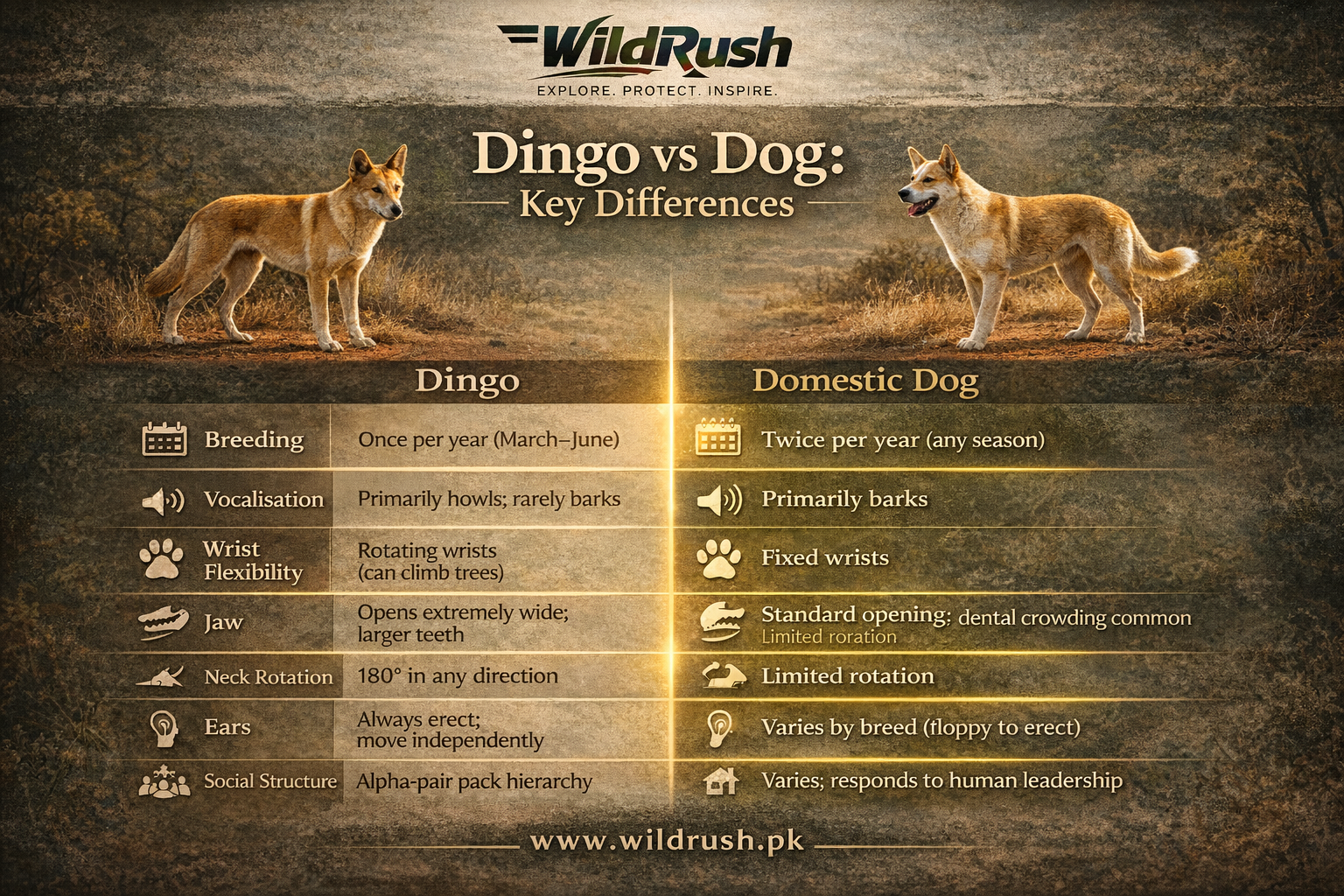
Key physical differences between dingoes and domestic dogs — from ear shape and jaw structure to coat pattern and build.
Can You Keep a Dingo as a Pet?
This is one of the most searched dingo-related questions, and the answer depends heavily on where you live in Australia. Keeping a dingo as a pet is illegal in Tasmania, Queensland, and South Australia. In New South Wales and other states, it may be permitted with specific licences and permits.
Those who do keep dingoes report that they can be affectionate and loyal companions when raised from a very young age — but they are emphatically not like domestic dogs. Dingoes are high-maintenance animals that require enormous amounts of attention, socialisation, and space. They are territorial, dislike changes in environment, and their pack instincts mean isolation or neglect can trigger destructive and even aggressive behaviour.
Cultural Significance
The dingo holds deep cultural significance for Indigenous Australians, featuring prominently in Dreamtime stories, songlines, and totemic relationships across many Aboriginal nations. The word "warrigal" (or "warragul"), meaning "wild dog," comes from the Dharug language of the Sydney basin area.
For many Traditional Owner groups, the dingo is not merely an animal but an intrinsic part of Country — connected to law, kinship, and the spiritual landscape. Historically, Indigenous Australians formed close relationships with dingoes, and the animals played roles in hunting, companionship, and warmth (the expression "three-dog night," referring to a bitterly cold night, has roots in this practice).
Any comprehensive conservation strategy for dingoes must respect and incorporate the knowledge and perspectives of Traditional Owners — something that has been lacking in past management approaches.
10 Fascinating Dingo Facts
- Dingoes have been in Australia for at least 3,500 years — longer than the Egyptian pyramids have existed
- They can rotate their wrists like humans, allowing them to open doors, latches, and even turn knobs
- Dingoes can climb trees and have been photographed perched on branches while scanning for prey
- The Dingo Fence is over 5,600 km long — more than twice the length of the Great Wall of China's main line
- Dingoes are monogamous and typically mate for life with their alpha partner
- They are the largest land predator in Australia and are classified as apex predators
- A dingo's howl can carry for kilometres across the outback, and they use at least 10 distinct vocalisations
- Unlike domestic dogs, dingoes do not have a "doggy" smell — they self-groom much like cats
- Dingoes have been tracked running at speeds up to 60 km/h and covering 40 km in a single day
- On K'gari (Fraser Island), the dingo population is considered one of the purest in Australia due to the island's isolation
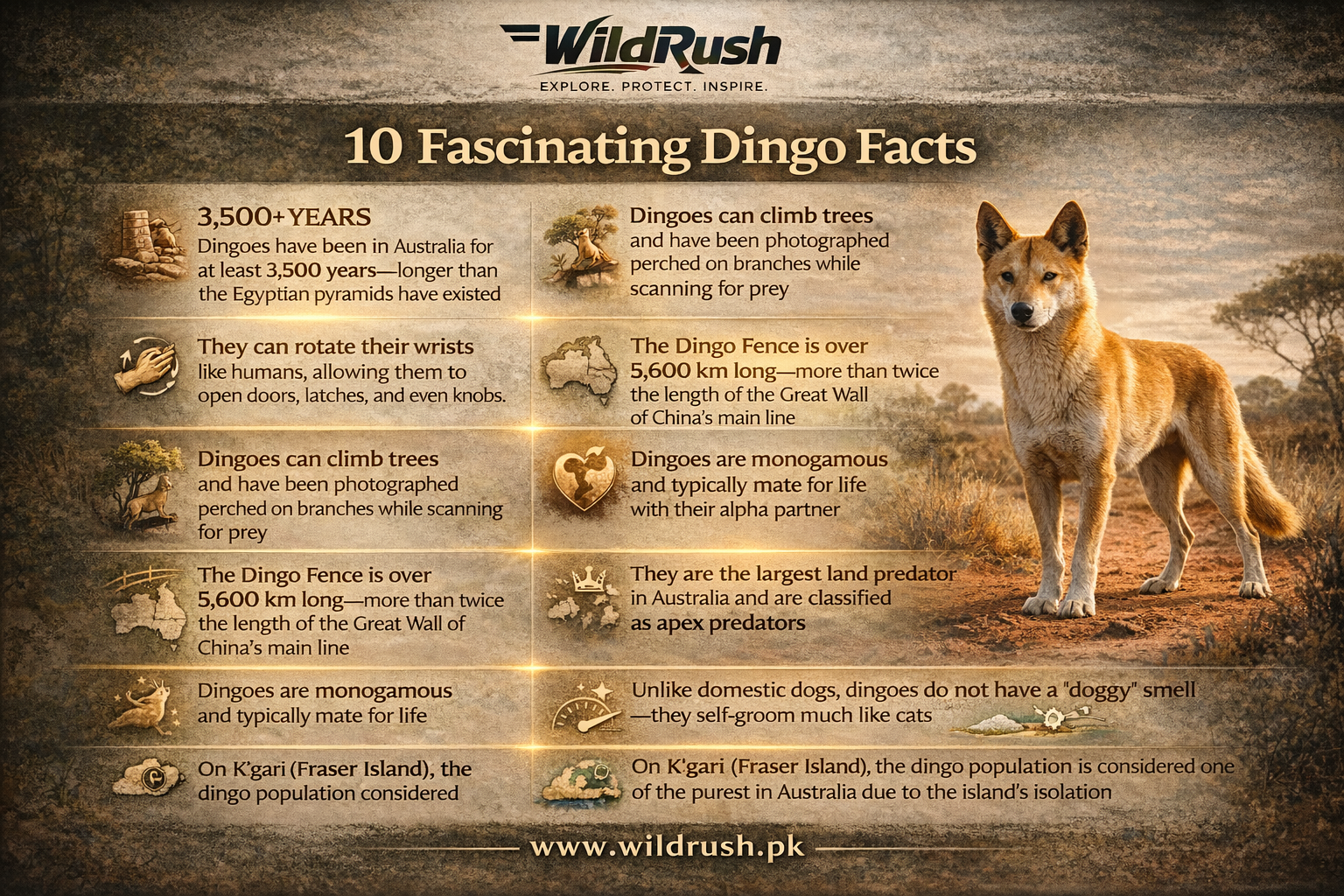
10 fascinating dingo facts: from their ability to climb trees and rotate wrists to their speed, hunting skills, and life in the Australian outback.
Frequently Asked Questions
Conclusion
The dingo is far more than just a wild dog roaming the Australian outback. It is an ancient canine lineage, a keystone predator maintaining ecological balance, a culturally significant animal for Indigenous Australians, and an increasingly threatened species caught between conflicting human interests.
Understanding the dingo — its origins, behaviour, ecological role, and the complex threats it faces — is essential for anyone who cares about Australian wildlife. Whether the dingo ultimately thrives or declines will depend on the choices made by policymakers, landowners, conservationists, and the public in the years ahead.
At WildRush Pakistan, we believe that knowledge is the first step toward conservation. Whether it's understanding snake bite first aid, learning safe snake handling techniques, or discovering the fascinating world of the Indian Monitor Lizard — every article we publish aims to bring you closer to the natural world. Share this guide with anyone who wants to learn about one of the world's most fascinating — and misunderstood — wild animals. 🐕🌿