Key Takeaways
- Varanus bengalensis — A large, non-venomous reptile found across South Asia, growing up to 175 cm in length
- Diet: Opportunistic carnivore feeding on insects, eggs, rodents, crabs, and carrion — a natural pest controller
- Behavior: Shy and reclusive — avoids humans and only defends itself when cornered
- Conservation: Listed under CITES Appendix I and protected under Pakistan's wildlife laws; threatened by habitat loss, illegal trade, and superstition
- Fun Fact: Monitor lizards are excellent swimmers, skilled climbers, and can run at speeds up to 28 km/h
Table of Contents
Introduction to the Indian Monitor Lizard
Imagine you're in a rural village in Punjab, Pakistan. A family discovers a large, scaly reptile hiding beneath a pile of firewood in their courtyard. Panic sets in — but should it? The Indian Monitor Lizard (Varanus bengalensis) is one of the most misunderstood creatures in South Asia. Despite its intimidating size and prehistoric appearance, this remarkable reptile is completely non-venomous, profoundly shy, and ecologically vital.
In this comprehensive guide, we break down everything you need to know about the Bengal Monitor — from its anatomy and behavioral patterns to its conservation status, real-life rescue operations, and the myths that continue to put this species at risk across India, Pakistan, Bangladesh, and Sri Lanka.
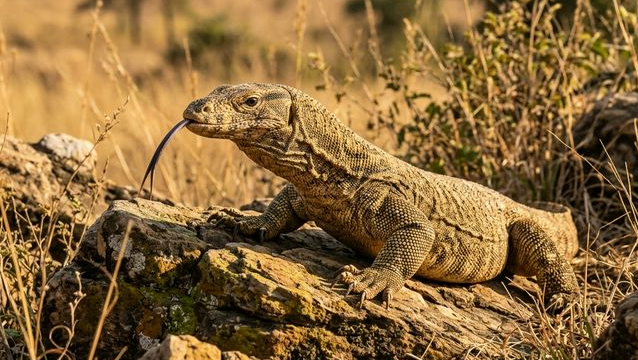
An Indian Monitor Lizard basking in its natural grassland habitat — a common sight across rural South Asia.
Overview & Physical Characteristics
The Indian Monitor Lizard, scientifically classified as Varanus bengalensis, belongs to the family Varanidae — a group of large, predatory lizards found across Africa, Asia, and Oceania. Often called the Bengal Monitor, Common Indian Monitor, or locally known as "Goh" (گوہ) in Urdu and Punjabi, this species is one of the largest lizards found on the Indian subcontinent.
Taxonomy & Classification
| Classification | Detail |
|---|---|
| Kingdom | Animalia |
| Phylum | Chordata |
| Class | Reptilia |
| Order | Squamata |
| Family | Varanidae |
| Genus | Varanus |
| Species | V. bengalensis |
| Common Names | Indian Monitor, Bengal Monitor, Common Monitor, Goh (گوہ) |
Physical Features
Adult Indian Monitor Lizards can grow up to 175 cm (5.7 feet) in total length, with nearly half of that being the muscular, laterally compressed tail. They typically weigh between 7 to 15 kg, though larger specimens have been recorded in undisturbed habitats.
- Skin: Covered in tough, granular keeled scales ranging in color from olive-brown to dark grey, with faint yellowish or cream ocelli (eye-like spots) arranged in transverse rows
- Tongue: A long, deeply forked tongue used for chemoreception — detecting chemical signals in the air to locate food, mates, and predators
- Claws: Five sharp, curved claws on each foot, adapted for digging burrows, climbing trees, and tearing apart prey
- Tail: A powerful, whip-like tail used for balance, swimming, and as a defensive weapon when threatened
- Eyes: Well-developed eyes with round pupils providing good binocular vision; they can detect movement from considerable distances
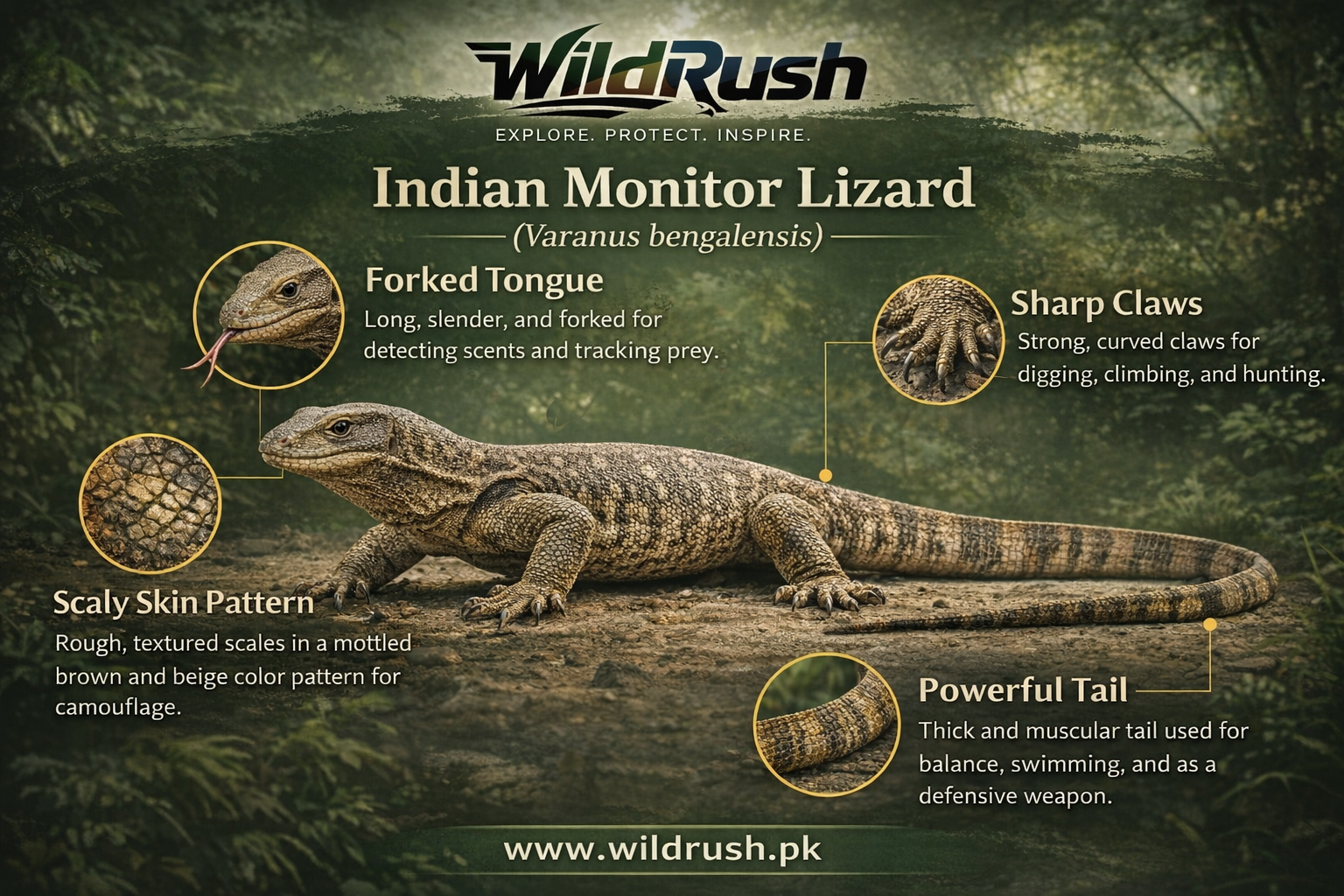
Anatomy of the Indian Monitor Lizard — forked tongue, sharp claws, muscular tail, and keeled scales are key adaptations.
Habitat & Distribution
The Indian Monitor Lizard has one of the widest distributions among all monitor lizard species in Asia. Its geographic range spans across the entire Indian subcontinent and extends into parts of Southeast Asia.
Geographic Range
Populations of Varanus bengalensis are found in India, Pakistan, Nepal, Bangladesh, Sri Lanka, Afghanistan (eastern border regions), and parts of Myanmar and Iran. In Pakistan, they are most commonly seen in Punjab, Sindh, southern Khyber Pakhtunkhwa (KPK), and Balochistan.
Preferred Environments
This species demonstrates impressive ecological adaptability. They thrive in a wide range of habitats:
- Tropical and subtropical dry forests — across the plains of Punjab and Rajasthan
- Agricultural lands and farmlands — where rodent prey is abundant
- Riverbanks, wetlands, and canal systems — especially in Sindh and southern Punjab
- Rocky outcrops and scrublands — in arid zones of Balochistan and Thar
- Urban and semi-urban areas — gardens, construction sites, drainage systems, and even inside homes
Behavior & Diet
Understanding the behavioral ecology of the Indian Monitor Lizard is essential for coexistence. These reptiles are far more complex than most people realize — exhibiting problem-solving abilities, spatial memory, and sophisticated foraging strategies.
Activity Patterns
The Bengal Monitor is primarily diurnal — most active during daylight hours, especially in the morning when they bask in sunlight to raise their body temperature (thermoregulation). In extremely hot climates like the Thar Desert or Sindh plains, they may become crepuscular, shifting activity to early morning and late afternoon to avoid peak heat.
Feeding Habits
Indian Monitor Lizards are opportunistic carnivores with an incredibly diverse diet. Their flexible feeding strategy makes them both effective predators and vital scavengers:
| Food Category | Examples | Hunting Method |
|---|---|---|
| Invertebrates | Beetles, ants, termites, scorpions, land snails | Tongue-flicking search, digging |
| Eggs | Bird eggs, turtle eggs, crocodile eggs | Nest raiding |
| Amphibians | Frogs, toads | Ambush near water |
| Small Mammals | Rats, mice, young rabbits | Active pursuit |
| Reptiles | Smaller lizards, snake eggs | Foraging, digging |
| Fish & Crabs | Freshwater fish, river crabs | Swimming, shoreline foraging |
| Carrion | Dead animals, roadkill | Scavenging |
Defensive Behavior
When threatened, the Indian Monitor employs a series of graduated defensive responses:
- Freeze & Camouflage: First instinct is to stay perfectly still, relying on cryptic coloration
- Flee: If detected, the lizard will attempt rapid escape — running bipedally at speeds up to 28 km/h
- Hissing & Puffing: Inflates its body, opens its mouth wide, and produces a loud hissing sound
- Tail Whipping: Uses its powerful muscular tail as a whip — the most common defensive attack
- Biting: Only as a last resort; bites are rare and typically non-serious
Interaction with Humans
One of the biggest challenges facing the Indian Monitor Lizard is the widespread fear and superstition surrounding it. In many parts of Pakistan and India, these harmless reptiles are killed on sight due to deeply rooted myths.
Common Myths vs Reality
| ❌ Myth | ✅ Reality |
|---|---|
| "Monitor lizards are venomous" | Completely non-venomous. They do not produce any venom. |
| "Their bite is fatal" | Bites are rare and cause only minor injuries. No deaths have been recorded. |
| "They attack humans aggressively" | They are shy and avoid humans. They only defend themselves when cornered. |
| "They are poisonous to touch" | Their skin is harmless. There is no poison or toxin on their body. |
| "Their tail whip causes paralysis" | While powerful, a tail strike causes a welt at most — no paralysis. |
Safety Tips for Encounters
If you encounter an Indian Monitor Lizard in or around your home, here's what to do:
- Stay calm — the lizard is more afraid of you than you are of it
- Do not chase or corner it — this triggers defensive behavior
- Keep children and pets away — give the lizard space
- Close doors to limit its movement to one area
- Contact a wildlife rescuer — call WildRush Pakistan or local wildlife authorities
- Never attempt to handle it yourself — their claws and tail can cause injury to untrained handlers
Real Rescue: Field Experience in Pakistan
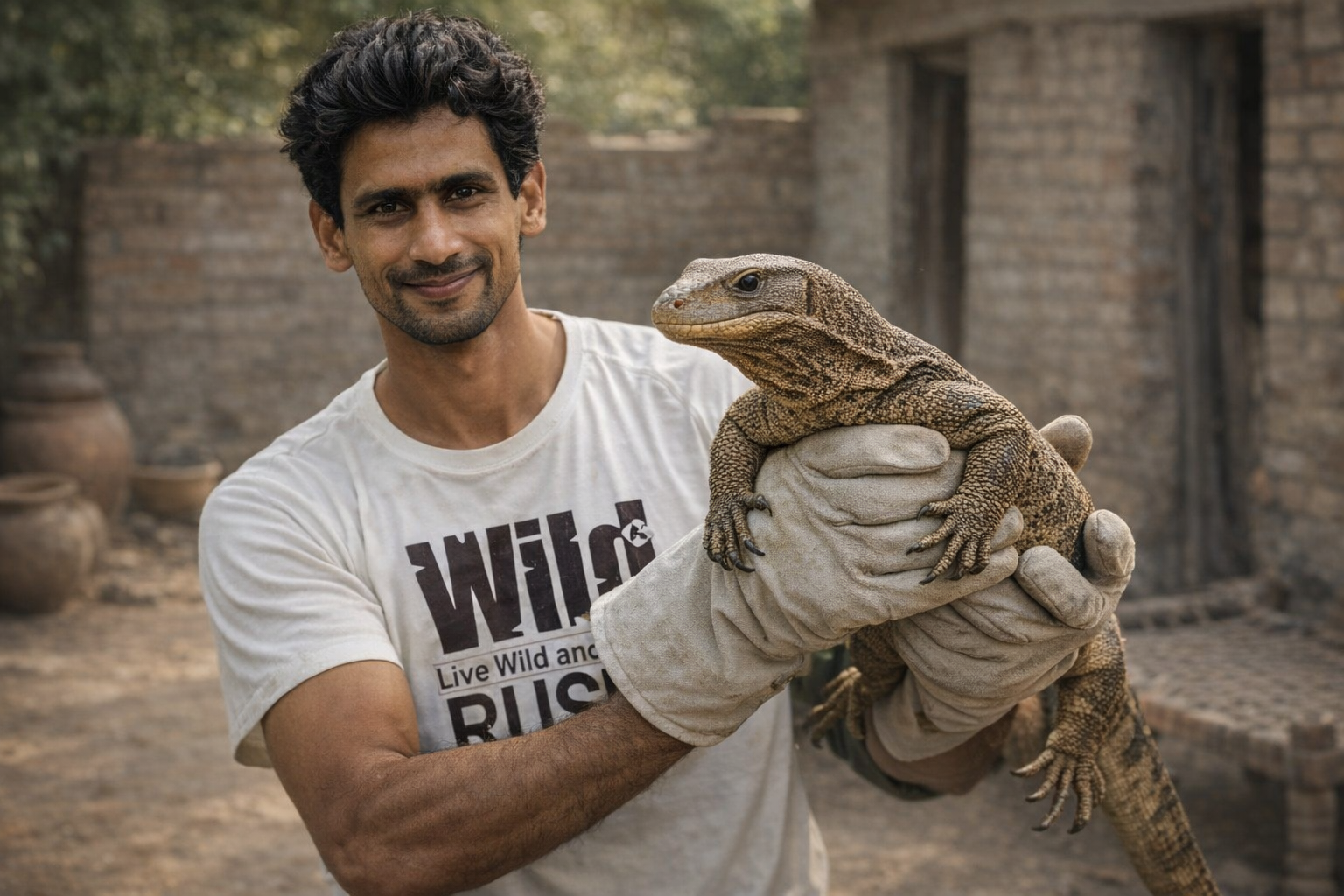
A WildRush Pakistan field rescue — safely capturing an Indian Monitor Lizard found in a residential home.
Our team at WildRush Pakistan received a call from a family in a rural village. An Indian Monitor Lizard had entered their home and hidden under a pile of firewood ("baalan") in the courtyard.
The family first noticed the lizard while preparing dough in the kitchen area. The reptile had apparently been sheltering in the loose soil beneath the firewood stack and suddenly emerged, startled, before running back for cover. By the time we arrived, the lizard was resting quietly inside the woodpile — motionless, relying on its natural camouflage.
Using patience and proper handling techniques, our team carefully removed the surrounding wood and safely captured the monitor lizard without harming it. The animal was later relocated to a secure natural environment near a canal system with abundant vegetation and prey.
- Monitor lizards avoid humans — this one was hiding, not stalking
- They only hide when scared — its instinct was to freeze and camouflage
- They do not attack without reason — even after being disturbed, it chose flight over fight
Conservation Status & Threats
The Indian Monitor Lizard faces significant conservation challenges across its range, despite being one of the most widespread monitor species in Asia.
Legal Protection Status
| Framework | Status |
|---|---|
| IUCN Red List | Least Concern (population declining) |
| CITES | Appendix I — banned from international trade |
| Indian Wildlife Protection Act | Schedule I — highest protection category |
| Pakistan Wildlife Ordinance | Protected species — hunting and trade illegal |
Major Threats
- Habitat destruction: Urbanization, deforestation, and agricultural expansion are destroying nesting and foraging sites
- Illegal hunting: Killed for traditional medicine, leather, and fat (believed to have curative properties — this is false)
- Superstition and fear: Killed on sight in many rural areas due to myths about venom and aggression
- Road mortality: Frequently killed by vehicles while crossing roads, especially near canal embankments
- Pesticide poisoning: Ingestion of contaminated prey in agricultural areas treated with organophosphate pesticides
Why Conservation Matters
The Indian Monitor Lizard is a keystone scavenger and mesopredator in South Asian ecosystems. Without them:
- Rodent populations would surge, increasing crop damage by billions of rupees
- Insect pest outbreaks would become more frequent in agricultural zones
- Carrion accumulation would increase disease transmission risks
- Their burrows — which provide shelter for other species — would disappear, reducing habitat complexity
Interesting Facts About the Indian Monitor Lizard
- Speed demons: They can sprint at up to 28 km/h and even run on their hind legs (bipedal locomotion) for short distances
- Excellent swimmers: Using their laterally flattened tail as a rudder, they can swim across rivers and canals with ease
- Tree climbers: Despite their bulk, they regularly climb trees to raid bird nests and escape predators
- Intelligent hunters: Studies have shown monitors can count up to six and demonstrate spatial learning — remembering locations of food sources
- Long lifespan: In the wild, they can live 15–20 years; in captivity, some have exceeded 25 years
- Egg layers: Females lay 10–30 eggs per clutch in burrows or termite mounds. Incubation takes about 6–8 months
- Jacobson's organ: Their forked tongue delivers chemical particles to the vomeronasal organ (Jacobson's organ) in the roof of their mouth — giving them a smell-based "3D map" of their environment
- Cultural significance: In Sanskrit, they are called "Godhā" — referenced in ancient texts like the Arthashastra and Panchatantra. The word "monitor" itself may come from their habit of standing on hind legs as if "monitoring" their surroundings
Watch: Live Rescue of an Indian Monitor Lizard
Watch our WildRush Pakistan team conduct a real rescue operation of an Indian Monitor Lizard from an urban home. This video documents the entire process — from the initial discovery to safe capture and relocation in a natural habitat.
🎬 Watch a live rescue of an Indian Monitor Lizard from an urban home — by WildRush Pakistan.
Frequently Asked Questions
Conclusion
The Indian Monitor Lizard is far more than a "scary reptile." It is a highly intelligent, ecologically vital, and deeply misunderstood species that plays a critical role in keeping South Asian ecosystems healthy and balanced. From controlling rodent populations in agricultural fields to cleaning up carrion in rural villages, the Bengal Monitor is a silent guardian of the landscapes we depend on.
At WildRush Pakistan, we believe in education over fear. Every rescue we conduct is a reminder that coexistence is not only possible — it's essential. The next time you see a monitor lizard, remember: it's not there to harm you. It's simply living its life — and it needs your understanding and protection.
Share this article to help break the myths. Together, we can protect Pakistan's wildlife — one species at a time. 🌿